President Who Was in and Then Someone Else Was President When He Was President Again

7c. Selection and Succession of the President
The founders feared the masses. Cautious near granting powers to the general voting public, they created a rubber valve confronting popular volition. The American people do not technically elect their President. Electors exercise.
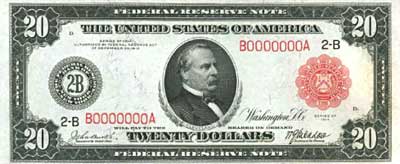
Grover Cleveland, shown on a $twenty Federal Reserve Note from 1914, won the pop vote in his second election, only lost the presidency considering he failed to win the electoral college.
Selection
Co-ordinate to the Constitution, the President serves a four-twelvemonth term of office. The 22nd Subpoena further requires that a President may not be elected more than than twice, nor serve more than a total of ten years. The Constitution also created an electoral college to select the President.
Some of the founders wanted to select a President by popular vote, but others did not desire to put that much power into the hands of the voters. Others believed that Congress should select the President, but so, what would happen to separation of powers and checks and balances? And then they compromised and created a special body of electors to exist selected by u.s.a.. The number of electors would be equal to the sum of a states Senators and Representatives, so that large states would have more electors than the small ones.
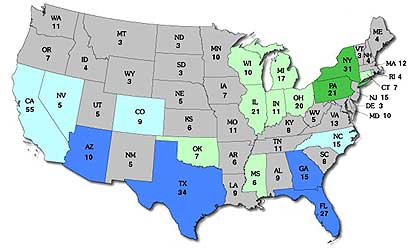
Some people believe that the electoral college system gives some states more or less than their fair share of votes. For example, California's population makes up virtually 12% the full U.South. population, but they receive only 10% of the nation's electoral votes. This map shows the changes fabricated to the Electoral Higher based on the 2000 census.
Today many people believe that the Electoral College is out of date and that Presidents should be chosen by direct ballot, just as members of Congress are selected. By convention, state electors vote for the candidate that the people select in the general election, but they are not necessarily bound to do so.
The Electoral Higher also adds one nettlesome wrinkle — information technology is possible for a President to win more of the popular vote and lose the election. For instance, if the Republican candidate gets even 1 more vote than the Democrat, all the land's electoral votes go to the Republican. Therefore, if a candidate wins a number of states with large balloter college members by small pluralities and carries plenty states with modest electoral higher members to gain the necessary 270 electoral college votes, it is possible for a candidate to receive less popular votes than an opponent, and nevertheless win the Presidential election. 5 presidents — John Quincy Adams, Rutherford B. Hayes, Benjamin Harrison, George W. Bush and Donald Trump — take been elected in this fashion.
Succession
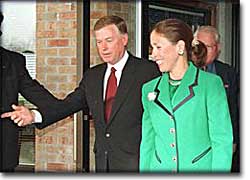
Vice President Dan Quayle became the butt of many jokes when he misspelled the word "white potato" while judging an elementary school spelling bee. Similar virtually Vice Presidents before him, Quayle failed to win the next presidential election.
The Constitution originally said piddling well-nigh presidential succession. It only specified that powers and duties should "devolve on the Vice President." Numerous succession situations over the years accept shaped the current policy, defined in the 25th Subpoena, adopted in 1967.
25th Amendment
Section 1.
In case of the removal of the President from office or of his death or resignation, the Vice President shall get President.
Department 2.
Whenever there is a vacancy in the office of the Vice President, the President shall nominate a Vice President who shall take office upon confirmation by a bulk vote of both Houses of Congress.
Section 3.
Whenever the President transmits to the President pro tempore of the Senate and the Speaker of the House of Representatives his written proclamation that he is unable to discharge the powers and duties of his role, and until he transmits to them a written declaration to the reverse, such powers and duties shall be discharged by the Vice President every bit Interim President.
Department 4.
Whenever the Vice President and a majority of either the principal officers of the executive departments or of such other trunk as Congress may by law provide, transmits to the President pro tempore of the Senate and the Speaker of the House of Representatives their written declaration that the President is unable to discharge the powers and duties of his office, the Vice President shall immediately assume the powers and duties of the office as Acting President. Thereafter, when the President transmits to the President pro tempore of the Senate and the Speaker of the House of Representatives his written annunciation that no inability exists, he shall resume the powers and duties of his office unless the Vice President and a bulk of either the chief officers of the executive department or of such other body equally Congress may by constabulary provide, transmit within 4 days to the President pro tempore of the Senate and the Speaker of the House of Representatives their written proclamation that the President is unable to discharge the powers and duties of his role. Thereupon Congress shall decide the issue, assembling within forty-eight hours for that purpose if not in session. If the Congress, within twenty-one days later on receipt of the latter written declaration, or, if Congress is non in session, within twenty-one days later Congress is required to assemble, determines past ii-thirds vote of both Houses that the President is unable to discharge the powers and duties of his office, the Vice President shall continue to discharge the aforementioned equally Acting President; otherwise, the President shall resume the powers and duties of his office.
What happens when the presidency is vacated before an election? The Vice President becomes President, and so selects a Vice President that must be confirmed by both houses of Congress. What if something should happen to the President and Vice President at the same fourth dimension? Then the Speaker of the House takes the presidency, and the President pro tempore of the Senate becomes Vice President. The line of succession then goes to the Cabinet members, in the guild of their creation.
Order of Succession to the Presidency
| 1 — President of the United States |
| 2 — Vice-President of the United States |
| 3 — Speaker of the House of Representatives |
| 4 — President of the Senate Pro Tempore (becomes VP when Speaker becomes President) |
| (Cabinet Secretaries in Order of Post'due south Creation — see Unit of measurement 7) |
| five — Secretary of Land |
| 6 — Secretarial assistant of the Treasury |
| 7 — Secretary of Defense |
| viii — Attorney General |
| 9, etc. — Remaining Cabinet Secretaries |

The Vice President
What does the Vice President do? The only given constitutional duty is to preside over the Senate, a job with virtually no power since the Vice President can only vote in the result of a tie. Indeed, the nation's first Vice President, John Adams, called the mail service "the most insignificant function that always the invention of man contrived."
The President, then, has nearly full control over what the Vice President does. If he chooses to give him many responsibilities, The Vice President can have a pregnant amount of power if the President is willing to delegate it.
In recent years Presidents have given their Vice Presidents more and more to do. They have headed commissions and organized major projects. The Vice President often makes goodwill missions and attends ceremonies and celebrations. If the President regularly asks for advice, then the Vice President has some existent, though indirect, ability.
This dependency on the President has made information technology very difficult for a Vice President to successfully run for President. Only twice in American history has a seated Vice President been elected to the presidency. In 1837, Vice President Martin Van Buren succeeded Andrew Jackson, and in 1989, Vice President George Bush succeeded Ronald Reagan. In neither instance, did they win reelection.
Source: https://www.ushistory.org/gov/7c.asp

Post a Comment for "President Who Was in and Then Someone Else Was President When He Was President Again"