What government agency was established after the Civil War to assist newly freed slaves?

A Bureau agent stands between a group of whites and a group of freedmen. Harper's Weekly, July 25, 1868.
The Bureau of Refugees, Freedmen, and Abandoned Lands, commonly referred to as simply the Freedmen'southward Bureau,[1] was an agency of early Reconstruction, assisting freedmen in the South. Information technology was established on March 3, 1865, and operated briefly as a U.S. government agency, from 1865 to 1872, after the American Ceremonious War, to direct "provisions, wearable, and fuel...for the immediate and temporary shelter and supply of destitute and suffering refugees and freedmen and their wives and children".[2]
Groundwork and operations [edit]
In 1863, the American Freedmen'southward Inquiry Commission was established. Two years later, as a result of the inquiry[3] [iv] the Freedmen's Bureau Neb was passed, which established the Freedmen'southward Bureau as initiated past U.South. President Abraham Lincoln. It was intended to final for one year later on the end of the Ceremonious War.[v] The Agency became a office of the United states Department of War, as Congress provided no funding for it. The War Department was the only agency with funds the Freedmen's Agency could employ and with an existing presence in the South.
Headed by Union Ground forces Full general Oliver O. Howard, the Bureau started operations in 1865. From the beginning its representatives found its tasks very difficult, partly because Southern legislatures passed Black Codes that restricted move, weather condition of labor, and other civil rights of African Americans, nearly duplicating conditions of slavery. Besides, the Freedmen's Agency controlled only a limited amount of abundant country.[vi]
The Agency's powers were expanded[ by whom? ] to help African Americans notice family members[ how? ] from whom they had become separated during the war. It bundled to teach them to read and write—skills considered critical by the freedmen themselves as well equally by the government.[7] Bureau agents also served as legal advocates for African Americans in both state and federal courts, mostly in cases dealing with family bug.[seven] The Agency encouraged one-time major planters to rebuild their plantations and pay wages to their formerly-enslaved workers. It kept an eye on contracts between the newly-free laborers and planters, since few freedmen could read, and pushed whites and blacks to piece of work together in a free-labor market as employers and employees rather than as masters and slaves.[7]
In 1866 Congress renewed the charter for the Bureau. President Andrew Johnson, a Southern Democrat who had succeeded to the office post-obit Lincoln's assassination[8] in 1865, vetoed the nib, arguing that the Bureau encroached on states' rights, relied inappropriately on the armed forces in peacetime, gave blacks aid that poor whites had never had, and would ultimately prevent freed slaves from becoming self sufficient by rendering them dependent on public assistance.[5] [9] Though the Republican controlled Congress, overrode Johnson'due south veto, past 1869 Southern Democrats in Congress had deprived the Bureau of virtually of its funding[ how? ], and as a result it had to cut much of its staff.[5] [10] By 1870 the Agency had been weakened further due to the rise of Ku Klux Klan (KKK) violence across the South; members of the KKK and other terrorist organizations, attacked both blacks and sympathetic white Republicans, including teachers.[5] Northern Democrats also opposed the Agency's piece of work, painting information technology as a program that would make African Americans "lazy".[eleven]
In 1872 Congress abruptly abandoned the plan, refusing to approve renewal legislation. Information technology did non inform Howard, whom U.S. President Ulysses Due south. Grant had transferred to Arizona to settle hostilities betwixt the Apache and settlers. Grant's Secretary of War William W. Belknap was hostile to Howard's leadership and authority at the Bureau. Belknap angry controversy amidst Republicans by his reassignment of Howard.[ commendation needed ]
Achievements [edit]
Day-to-day duties [edit]
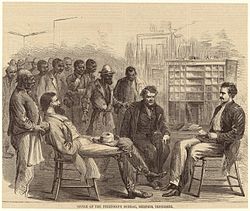
The Freedmen's Bureau office in Memphis, Tennessee, 1866.
The Bureau mission was to assistance solve everyday bug of the newly freed slaves, such as obtaining nutrient, medical care, communication with family members, and jobs. Between 1865 and 1869, it distributed xv million rations of nutrient to freed African Americans and 5 million rations to impoverished whites,[12] and set up a system by which planters could infringe rations in society to feed freedmen they employed. Although the Bureau set aside $350,000 for this latter service, simply $35,000 (10%) was borrowed by planters.[ citation needed ]
The Bureau's humanitarian efforts had limited success. Medical treatment of the freedmen was severely deficient,[thirteen] equally few Southern doctors, all of whom were white, would care for them. Much infrastructure had been destroyed by the war, and people had few ways of improving sanitation. Blacks had picayune opportunity to go medical personnel. Travelers unknowingly carried epidemics of cholera and yellow fever forth the river corridors, which broke out beyond the Due south and acquired many fatalities, especially among the poor.
Gender roles [edit]
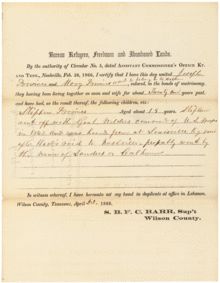
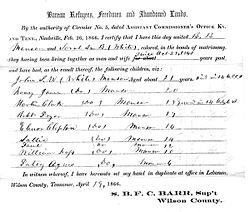
A certificate of wedlock issued by the Freedmen's Agency
Freedman's Agency agents initially complained that freedwomen were refusing to contract their labor. One of the first actions blackness families took for independence was to withdraw women's labor from fieldwork. The Agency attempted to force freedwomen to work by insisting that their husbands sign contracts making the whole family available every bit field labor in the cotton industry, and by declaring that unemployed freedwomen should be treated equally vagrants just as black men were.[14] The Bureau did allow some exceptions, such as married women with employed husbands, and some "worthy" women who had been widowed or abandoned and had big families of small children to care for. "Unworthy" women, meaning the unruly and prostitutes, were usually the ones subjected to punishment for vagrancy.[15]
Earlier the Civil State of war the enslaved could not marry legally, and nigh marriages had been breezy, although planters often presided over "marriage" ceremonies for their enslaved.[ citation needed ] After the war, the Freedmen's Bureau performed numerous marriages for freed couples who asked for it. Every bit many husbands, wives, and children had been forcibly separated under slavery, the Agency agents helped families reunite later on the state of war. The Bureau had an breezy regional communications organization that allowed agents to send inquiries and provide answers. It sometimes provided transportation to reunite families. Freedmen and freedwomen turned to the Agency for assist in resolving problems of abandonment and divorce.
Education [edit]
The most widely recognized accomplishments of the Freedman's Bureau were in instruction. Prior to the Ceremonious State of war, no Southern state had a system of universal, state-supported public didactics; in improver, nigh had prohibited both enslaved and free blacks from gaining an teaching. This meant learning to read and write, and do simple arithmetic. Former slaves wanted public instruction while the wealthier whites opposed the thought. Freedmen had a strong desire to learn to read and write; some had already started schools at refugee camps; others worked difficult to establish schools in their communities even prior to the advent of the Freedmen's Agency.
Oliver Otis Howard was appointed as the kickoff Freedmen's Agency Commissioner. Through his leadership, the bureau fix upwardly four divisions: Government-Controlled Lands, Records, Fiscal Diplomacy, and Medical Affairs. Instruction was considered role of the Records division. Howard turned over confiscated property including planters' mansions, government buildings, books, and furniture to superintendents to exist used in the didactics of freedmen. He provided transportation and room and board for teachers. Many Northerners came southward to educate freedmen.
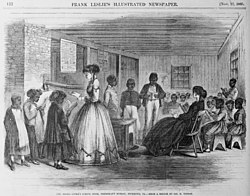
The Misses Cooke's school room, Freedmen's Bureau, Richmond, Virginia, 1866.
By 1866, Northern missionary and assist societies worked in conjunction with the Freedmen'southward Bureau to provide education for erstwhile slaves. The American Missionary Association was particularly agile, establishing eleven "colleges"[ which? ] in Southern states for the education of freedmen. The primary focus of these groups was to raise funds to pay teachers and manage schools, while the secondary focus was the day-to-day functioning of individual schools. Later 1866, Congress appropriated some funds to operate the freedmen's schools. The chief source of educational acquirement for these schools came through a Congressional Act that gave the Freedmen's Agency the power to seize Confederate property for educational use.
George Reddish, an African American, served every bit a teacher and schoolhouse ambassador and every bit a traveling inspector for the Agency, observing local conditions, aiding in the establishment of black schools, and evaluating the performance of Agency field officers. Blacks supported him, but planters and other whites opposed him.[16]
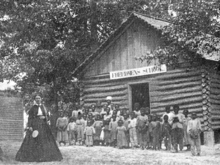
Freedmen'due south School, James Plantation, Due north Carolina
Overall, the Bureau spent $5 1000000 to prepare schools for blacks. By the finish of 1865, more than 90,000 sometime slaves were enrolled as students in such public schools. Omnipresence rates at the new schools for freedmen were nigh 80%.[ citation needed ] Brigadier General Samuel Chapman Armstrong created and led Hampton Normal and Agricultural Institute in Virginia in 1868. It is at present known every bit Hampton University.
The Freedmen's Bureau published their own freedmen's textbook. They emphasized the bootstrap philosophy, encouraging freedmen to believe that each person had the ability to work hard and to practice better in life.[ clarification needed ] These readers included traditional literacy lessons, as well as selections on the life and works of Abraham Lincoln, excerpts from the Bible focused on forgiveness, biographies of famous African Americans[ who? ] with emphasis on their piety, humbleness, and industry; and essays on humility, the work ethic, temperance, loving your enemies, and avoiding bitterness.[17]
By 1870, there were more than 1,000 schools for freedmen in the South.[18] J. W. Alvord, an inspector for the Bureau, wrote that the freedmen "have the natural thirst for knowledge," aspire to "ability and influence … coupled with learning," and are excited by "the special written report of books." Among the sometime slaves, both children and adults sought this new opportunity to larn. After the Bureau was abolished, some of its achievements collapsed under the weight of white violence against schools and teachers for blacks. Near Reconstruction-era legislatures had established public education but, later the 1870s, when white Democrats regained ability of Southern governments, they reduced funds available to fund public teaching, particularly for blacks. Beginning in 1890 in Mississippi, Autonomous-dominated legislatures in the South passed new state constitutions disenfranchising most blacks past creating barriers to voter registration. They so passed Jim Crow laws establishing legal segregation of public places. Segregated schools and other services for blacks were consistently underfunded past the Southern legislatures.[nineteen]
By 1871, Northerners' interest in reconstructing the South had waned. Northerners were showtime to tire of the effort that Reconstruction required, were discouraged by the high rate of continuing violence around elections, and were fix for the Southward to have care of itself. All of the Southern states had created new constitutions that established universal, publicly-funded education. Groups based in the North began to redirect their money toward universities and colleges founded to educate African-American leaders.[ citation needed ]
Teachers [edit]
Written accounts by northern women and missionary societies resulted in historians' overestimating their influence, writing that most Agency teachers were well-educated women from the North, motivated past religion and abolition to teach in the Southward. In the early 21st century, new enquiry has found that half the teachers were southern whites; one-tertiary were blacks (mostly southern), and i-6th were northern whites.[xx] Few were abolitionists; few came from New England. Men outnumbered women. The salary was the strongest motivation except for the northerners, who were typically funded by northern organizations and had a humanitarian motivation. Every bit a group, the black cohort showed the greatest commitment to racial equality; and they were the ones well-nigh likely to remain teachers. The school curriculum resembled that of schools in the north.[21]
Colleges [edit]
The building and opening by the AMA and other missionary societies of schools of higher learning for African Americans coincided with the shift in focus for the Freedmen's Aid Societies from supporting an simple education for all African Americans to enabling African-American leaders to proceeds loftier school and college educations. Some white officials working with African Americans in the South were concerned well-nigh what they considered the lack of a moral or financial foundation seen in the African-American community and traced that lack of foundation back to slavery.
Mostly, they believed that Blacks needed help to enter a free labor market place and rebuild a stable family unit life. Heads of local American Missionary Associations sponsored various educational and religious efforts for African Americans. Later efforts for higher education were supported by such leaders as Samuel Chapman Armstrong of the Hampton Plant and Booker T. Washington of the Tuskegee Constitute (from 1881). They said that blackness students should exist able to leave dwelling and "live in an atmosphere conducive not only to scholarship only to culture and refinement".[22]
Most of these colleges, universities and normal schools combined what they believed were the best fundamentals of a higher with that of the abode, giving students a basic structure to build adequate practices of upstanding lives. At many of these institutions, Christian principles and practices were also office of the daily authorities.
Educational legacy [edit]
Despite the untimely dissolution of the Freedman's Bureau, its legacy influenced the of import historically blackness colleges and universities (HBCUs), which were the chief institutions of higher learning for blacks in the South through the decades of segregation into the mid-20th century. Under the direction and sponsorship of the Agency, together with the American Missionary Clan in many cases, from approximately 1866 until its termination in 1872, an estimated 25 institutions of college learning for black youth were established.[23] The leaders among them go along to operate every bit highly ranked institutions in the 21st century and accept seen increasing enrollment.[24] (Examples of HBCUs include Howard University, St. Augustine's College, Fisk University, Johnson C. Smith University, Clark Atlanta Academy, Dillard Academy, Shaw University, Virginia Union University, and Tougaloo College).
As of 2009[update], there exist approximately 105 HBCUs that range in scope, size, organization, and orientation. Under the Instruction Act of 1965, Congress officially defined an HBCU as "an institution whose principal missions were and are the education of Black Americans". HBCUs graduate over 50% of African-American professionals, 50% of African-American public school teachers, and 70% of African-American dentists. In addition, l% of African Americans who graduate from HBCUs pursue graduate or professional degrees. Ane in three degrees held by African Americans in the natural sciences, and half the degrees held by African Americans in mathematics, were earned at HBCUs.[25] [ full citation needed ]
Perhaps the all-time known of these institutions is Howard University, founded in Washington, D.C., in 1867, with the aid of the Freedmen'south Bureau. It was named for the commissioner of the Freedmen's Bureau, General Oliver Otis Howard.[26] [ total citation needed ]
Church establishment [edit]
After the Civil War, control over existing churches was a contentious issue. The Methodist denomination had split into regional associations in the 1840s prior to the state of war, every bit had the Baptists, when Southern Baptists were founded. In some cities, Northern Methodists seized control of Southern Methodist buildings. Numerous northern denominations, including the independent black denominations of the African Methodist Episcopal (AME) and African Methodist Episcopal Zion, sent missionaries to the S to help the freedmen and plant new congregations. By this time the independent black denominations were increasingly well organized and prepared to deliver to the freedmen. Within a decade, the AME and AME Zion churches had gained hundreds of thousands of new members and were quickly organizing new congregations.[27]
Even before the war, blacks had established independent Baptist congregations in some cities and towns, such every bit Silvery Bluff and Charleston, Southward Carolina; and Petersburg and Richmond, Virginia. In many places, specially in more rural areas, they shared public services with whites. Often enslaved blacks met secretly to carry their own services away from white supervision or oversight.[27] After the war, freedmen mostly withdrew from the white-dominated congregations of the Baptist, Methodist and Presbyterian churches in order to be complimentary of white supervision. Within a short time, they were organizing black Baptist state associations and organized a national association in the 1890s.
Northern mission societies raised funds for land, buildings, teachers' salaries, and basic necessities such as books and furniture. For years they used networks throughout their churches to enhance money for freedmen's education and worship.[28]
Standing insurgency [edit]
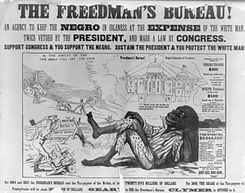
An 1866 affiche attacking the Freedmen'southward Bureau.
Most of the assistant commissioners, realizing that African Americans would not receive fair trials in the civil courts, tried to handle black cases in their own Bureau courts. Southern whites objected that this was unconstitutional. In Alabama, the Bureau commissioned state and county judges as Bureau agents. They were to try cases involving blacks with no distinctions on racial grounds. If a judge refused, the Freedmen'southward Bureau could plant martial law in his district. All just three judges accustomed their unwanted commissions, and the governor urged compliance.[29]
Possibly the virtually difficult region reported past the Freedmen's Bureau was Louisiana's Caddo and Bossier parishes in the northwest part of the state. It had not suffered wartime devastation or Union occupation, but white hostility was high against the black majority population. Well-meaning Bureau agents were understaffed and weakly supported by federal troops, and constitute their investigations blocked and authority undermined at every turn by recalcitrant plantation owners. Murders of freedmen were mutual, and white suspects in these cases were non prosecuted. Bureau agents did negotiate labor contracts, build schools and hospitals, and aid freedmen, but they struggled against the violence of the oppressive environment.[xxx]
In add-on to internal parish problems, this expanse was reportedly invaded by insurgents from Arkansas, described equally Desperadoes past the Bureau amanuensis in 1868.[31] In September 1868, for example, whites arrested and convicted 21 blacks accused of planning an insurrection in Bossier Parish. Henry Jones, accused of being the leader of the purported insurrection, was shot and left to burn past whites, but he survived, desperately hurt. Other freedmen were killed or driven from their land by Arkansas Desperadoes.[31] Whites were broken-hearted about their power equally blacks were to receive the franchise, and tensions were ascent over land use. In early on October, blacks arrested two whites from Arkansas "accused of beingness part of a mob ... that killed several Negroes." The agent reported xiv blacks had been killed in this incident, and so said that another viii to ten had been killed by the same Desperadoes. Blacks were reported to have killed the two white men in the altercation.[31] The whites' Arkansas friends and local whites went on a rampage confronting blacks in the surface area, resulting in more than than 150 blacks being killed.[32] [31]
In March 1872, at the request of President Ulysses Southward. Grant and the Secretary of the Interior, Columbus Delano, General Howard was asked to temporarily leave his duties as Commissioner of the Bureau to deal with Indian affairs in the westward. Upon returning from his consignment in November 1872, General Howard discovered that the Bureau and all of its activities had been officially terminated by Congress, effective as of June (Howard, 1907). While Full general Howard was dealing with Indian affairs in the west, the Freedmen's Bureau was steadily losing its back up in Congress. President Johnson had opposed the Freedmen's Bureau and his attitude encouraged many people, especially white Southerners, to challenge the Bureau. But insurgents showed that the war had not ended, every bit armed whites attacked black Republicans and their sympathizers, including teachers and officeholders. Congress dismantled the Bureau in 1872 due to pressure from white Southerners. The Bureau was unable to modify much of the social dynamic equally whites continued to seek supremacy over blacks, ofttimes with violence.[33]
In his autobiography, General Howard expressed smashing frustration about Congress having closed downwardly the agency. He said, "the legislative activity, however, was just what I desired, except that I would have preferred to close out my ain Bureau and non accept some other do it for me in an unfriendly style in my absence."[34] All documents and matters pertaining to the Freedmen's Bureau were transferred from the office of Full general Howard to the War Department of the Usa Congress.
State effectiveness [edit]
Alabama [edit]
The Bureau began distributing rations in the summer of 1865. Drought conditions resulted in and then much need that the state established its own Office of the Commissioner of the Destitute to provide boosted relief. The ii agencies coordinated their efforts starting in 1866. The Bureau established depots in 8 major cities. Counties were allocated aid in kind each calendar month based on the number of poor reported. The counties were required to provide transportation from the depots for the supplies. The ration was larger in wintertime and leap, and reduced in seasons when locally grown food was available.
In 1866, the depot at Huntsville provided five thousand rations a day. The food was distributed without regard to race. Corruption and abuse was so not bad that in October 1866, President Johnson ended in-kind aid in that state. Ane hundred twenty thousand dollars was given to the state to provide relief to the end of January 1867. Aid was ended in the land. Records show that by the terminate of the program, four times every bit many White people received assistance than did Black people.[35]
Florida [edit]
The Florida Bureau was assessed to be working effectively. Thomas Ward Osborne, the assistant commissioner of the Freedmen's Bureau for Florida, was an acute politician who collaborated with the leadership of both parties in the land. He was warmly praised by observers on all sides.[36] [37]
Georgia [edit]
The Agency played a major role in Georgia politics.[38] It was especially active in setting up, monitoring, and enforcing labor contracts for both men and women.[39] It also set up a new system of healthcare for the freedmen.[twoscore] Although a bulk of the agency's relief rations went to freedpeople, a large number of whites likewise benefited. In Georgia, poor whites received almost one-5th of the Bureau's rations.[41]
North Carolina [edit]
In N Carolina, the bureau employed: nine contract surgeons, at $100 per month; 26 infirmary attendants, at average pay each per month $11.25; 18 civilian employees, clerks, agents, etc., at an boilerplate pay per calendar month of $17.20; 4 laborers, at an average pay per month of $eleven.ninety; enlisted men are detailed as orderlies, guards, etc., by commanding officers of the different military posts where officers of the Agency are serving.[42]
Some misconduct was reported to the agency main office that bureau agents were using their posts for personal gains. Colonel E. Whittlesey was questioned but said he was non involved in nor knew of anyone involved in such activities. The agency exercised what whites believed were arbitrary powers: making arrests, imposing fines, and inflicting punishments. They were considered to be disregarding the local laws and peculiarly the statute of limitations. Their activities resulted in resentment among whites toward the federal authorities in general. These powers invoked negative feelings in many southerners that sparked many to desire the bureau to leave. In their review, Steedman and Fullerton repeated their conclusion from Virginia, which was to withdraw the Agency and turn daily operations over to the military.[43]
South Carolina [edit]
In S Carolina, the agency employed, 9 clerks, at average pay each per month $108.33, one rental agent, at monthly pay of $75.00, ane clerk, at monthly pay of $l.00, one storekeeper, at monthly pay of $85.00, i counselor, at monthly pay of $125.00, one superintendent of teaching, at monthly pay of $150.00, one printer, at monthly pay of $100.00, i contract surgeon, at monthly pay of $100.00, 20-5 laborers, at average pay per calendar month $19.twenty.
Full general Saxton was head of the bureau operations in South Carolina; he was reported by Steedman and Fullerton to have made so many "mistakes and blunders" that he made matters worse for the freedmen. He was replaced by Brigadier Full general R.K. Scott. Steedman and Fullerton described Scott every bit energetic and a competent officer. It appeared that he took not bad pains to plow things effectually and correct the mistakes made by his predecessors.
The investigators learned of reported murders of freedmen past a band of outlaws. These outlaws were thought to be people from other states, such as Texas, Kentucky and Tennessee, who had been part of the rebel army (Ku Klux Klan capacity were similarly started by veterans in the kickoff years later the state of war.) When citizens were asked why the perpetrators had not been arrested, many answered that the Bureau, with the support of the military machine, had the primary authority.[43]
In certain areas, such as the Bounding main Islands, many freedmen were destitute. Many had tried to cultivate the state and began businesses with picayune to no success in the social disruption of the period.[44]
Texas [edit]
Suffering much less damage in the war than some other Deep South states, Texas became a destination for some 200,000 refugee blacks from other parts of the S, in addition to 200,000 already in Texas. Slavery had been prevalent only in East Texas, and some freedmen hoped for the adventure of new types of opportunity in the lightly populated only booming state. The Bureau's political part was central, as was close attention to the need for schools.[45] [46] [47]
Virginia [edit]
The Freedmen'due south Bureau had 58 clerks and superintendents of farms, paid average monthly wages $78.50; 12 assistant superintendents, paid average monthly wages 87.00; and 163 laborers, paid average monthly wages 11.75; as personnel in the state of Virginia. Other personnel included orderlies and guards.[43]
During the war, slaves had escaped to Union lines and forts in the Tidewater, where contraband camps were established. Many stayed in that area afterward the war, seeking protection almost the federal forts. The Agency fed 9,000 to x,000 blacks a calendar month over the winter, explaining:
- "A bulk of the freedmen to whom this subsistence has been furnished are undoubtedly able to earn a living if they were removed to localities where labor could be procured. The necessity for issuing rations to this class of persons results from their accumulation in large numbers in sure places where the land is unproductive and the need for labor is limited. As long as these people remain in the present localities, the civil authorities refuse to provide for the able-bodied, and are unable to care for the helpless and destitute amid them, owing to their great number and the fact that very few are residents of the counties in which they have congregated during the state of war. The necessity for the relief extended to these people, both athletic and helpless, past the Authorities, will go along as long as they remain in their present condition, and while rations are issued to the athletic they volition not voluntarily alter their localities to seek places where they can procure labor.'[48]
Bureau records [edit]
In 2000, the U.Southward. Congress passed the Freedmen's Bureau Preservation Act, which directed the National Archivist to preserve the extensive records of the Bureau on microfilm, and work with educational institutions to alphabetize the records.[49] In addition to those records of the Bureau headquarters, assistant commissioners, and superintendents of teaching, the National Archives at present has records of the field offices, spousal relationship records, and records of the Freedmen'due south Branch of the Adjutant General on microfilm. They are being digitized and made available through online databases. These establish a major source of documentation on the operations of the Bureau, political and social conditions in the Reconstruction Era, and the genealogies of freedpeople.[l] [51] [a] The Freedmen's Agency Projection[53] (announced on June xix, 2015) was created every bit a set of partnerships betwixt FamilySearch International and the National Archives and Records Administration (NARA), the Smithsonian's National Museum of African American History and Culture, the Afro-American Historical and Genealogical Guild (AAHGS), and the California African American Museum. Tens of thousands of volunteers are needed to make these records searchable online. No specific time delivery is required, and anyone may participate. Volunteers only log on (http://www.discoverfreedmen.org/), pull up as many scanned documents as they like, and enter the names and dates into the fields provided. Once published, information for millions of African Americans will be attainable, allowing families to build their family trees and connect with their ancestors. Equally of February 2016, the project was 51% complete.
In October 2006, Virginia governor Tim Kaine appear that Virginia would be the beginning state to alphabetize and digitize Freedmen'south Agency records.[54]
Come across besides [edit]
- Us House Commission on Freedmen'south Diplomacy
- Freedmen's Savings Bank
- Forty acres and a mule
- Freedmen's Cemetery Chalmette, Louisiana
Bibliography [edit]
- run across also Reconstruction: Bibliography
Full general [edit]
- Bentley George R. A History of the Freedmen's Bureau (1955); onetime fashioned overview
- Carpenter, John A.; Sword and Olive Branch: Oliver Otis Howard (1999); full biography of Bureau leader
- Cimbala, Paul A. The Freedmen'south Bureau: Reconstructing the American South afterwards the Ceremonious War (2005)
- Cimbala, Paul A. and Trefousse, Hans L. (eds), The Freedmen's Bureau: Reconstructing the American S Later on the Civil War. 2005; essays past scholars.
- Colby, I. C. (1985). "The Freedmen's Bureau: From Social Welfare to Segregation". Phylon. 46 (3): 219–230. doi:x.2307/274830. JSTOR 274830.
- W. E. Burghardt Du Bois, The Freedmen'due south Bureau (1901). Archived October nineteen, 2003, at the Wayback Motorcar
- Foner, Eric. Reconstruction: America'south Unfinished Revolution, 1863–1877 (1988).[ full citation needed ]
- Goldberg, Republic of chad Alan. Citizens and Paupers: Relief, Rights, and Race, from the Freedmen'south Agency to Workfare (2007) compares the Agency with the WPA in the 1930s and welfare today extract and text search
- Litwack, Leon F. Been in the Tempest And then Long: The Aftermath of Slavery, 1979.[ total citation needed ]
- McFeely, William S. Yankee Stepfather: General O.O. Howard and the Freedmen (1994); biography of Agency's head. excerpt and text search
Instruction [edit]
- Abbott, Martin. "The Freedmen'southward Bureau and Negro Schooling in South Carolina," S Carolina Historical Magazine, Vol. 57#two (April., 1956), pp. 65–81 in JSTOR
- Anderson, James D. The Educational activity of Blacks in the Southward, 1860–1935 (1988).
- Butchart, Ronald Due east. Northern Schools, Southern Blacks, and Reconstruction: Freedmen'due south Education, 1862–1875 (1980).
- Hunker, Barry A. "Black Education in Civil War and Reconstruction Louisiana: George T. Ruby, the Army, and the Freedmen's Bureau" Louisiana History 1997 38(three): 287–308. ISSN 0024-6816.
- Goldhaber, Michael (1992). "A Mission Unfulfilled: Freedmen's Education in North Carolina, 1865–1870". Journal of Negro History. 77 (iv): 199–210. doi:10.2307/3031474. JSTOR 3031474. S2CID 141705550.
- Hornsby, Alton. "The Freedmen'southward Bureau Schools in Texas, 1865–1870," Southwestern Historical Quarterly, Vol. 76#iv (April, 1973), pp. 397–417 in JSTOR
- Jackson, 50. P. "The Educational Efforts of the Freedmen's Bureau and Freedmen's Help Societies in South Carolina, 1862–1872," The Periodical of Negro History (1923), vol 8#1, pp 1–xl. in JSTOR
- Jones, Jacqueline. Soldiers of Light and Love: Northern Teachers and Georgia Blacks, 1865–1873 (1980).
- Morris, Robert C. Reading, 'Riting, and Reconstruction: The Education of Freedmen in the South, 1861–1870 (1981).
- Myers, John B. "The Education of the Alabama Freedmen During Presidential Reconstruction, 1865–1867," Journal of Negro Teaching, Vol. forty#2 (Leap 1971), pp. 163–171 in JSTOR
- Parker, Marjorie H. "Some Educational Activities of the Freedmen'southward Bureau," Journal of Negro Education, Vol. 23#one (Winter, 1954), pp. nine–21. in JSTOR
- Richardson, Joe M. Christian Reconstruction: The American Missionary Association and Southern Blacks, 1861–1890 (1986)
- Richardson, Joe Chiliad. "The Freedmen'due south Bureau and Negro Teaching in Florida," Periodical of Negro Pedagogy, Vol. 31#4 (Fall, 1962), pp. 460–467. in JSTOR
- Span, Christopher M. "'I Must Acquire Now or Non at All': Social and Cultural Capital in the Educational Initiatives of Formerly Enslaved African Americans in Mississippi, 1862–1869," The Journal of African American History, 2002, pp. 196–222.
- Tyack, David, and Robert Lowe. "The Ramble Moment: Reconstruction and Blackness Educational activity in the Due south," American Journal of Education, Vol. 94#two (February 1986), pp. 236–256 in JSTOR
- Williams, Heather Andrea; "'Wear Themselves in Intelligence': The Freedpeople, Schooling, and Northern Teachers, 1861–1871", The Periodical of African American History, 2002, pp. 372+.
- Williams, Heather Andrea. Cocky-Taught: African American Instruction in Slavery and Freedom (2006). online edition
Specialized studies [edit]
- Bethel, Elizabeth . "The Freedmen's Bureau in Alabama," Journal of Southern History Vol. 14, No. one, (February 1948) pp. 49–92 in JSTOR.
- Bickers, John One thousand. "The Power to Do What Manifestly Must Be Done: Congress, the Freedmen'southward Bureau, and Constitutional Imagination", Roger Williams University Law Review, Vol. 12, No. seventy, 2006 online at SSRN.
- Cimbala, Paul A. "On the Front Line of Liberty: Freedmen'due south Bureau Officers and Agents in Reconstruction Georgia, 1865–1868," Georgia Historical Quarterly 1992 76(iii): 577–611. ISSN 0016-8297.
- Cimbala, Paul A. Nether the Guardianship of the Nation: the Freedmen'southward Bureau and the Reconstruction of Georgia, 1865–1870 (1997).
- Click, Patricia C. Time Full of Trial: The Roanoke Island Freedmen's Colony, 1862–1867 (2001).
- Crouch, Barry. The Freedmen's Bureau and Black Texans (1992).
- Crouch; Barry A. "The 'Chords of Love': Legalizing Black Marital and Family Rights in Postwar Texas," The Journal of Negro History, Vol. 79, 1994.
- Downs, Jim. Sick from Freedom: African-American Illness and Suffering during the Civil State of war and Reconstruction (Oxford University Printing, 2012)
- Durrill, Wayne K. "Political Legitimacy and Local Courts: 'Politicks at Such a Rage' in a Southern Customs during Reconstruction," in Periodical of Southern History, Vol. 70 #iii, 2004 pp. 577–617.
- Farmer-Kaiser, Mary. "'Are They Not in Some Sorts Vagrants?' Gender and the Efforts of the Freedmen's Bureau to Combat Vagrancy in the Reconstruction S," Georgia Historical Quarterly 2004 88(1): 25–49. ISSN 0016-8297.
- Farmer-Kaiser, Mary. Freedwomen and the Freedmen'south Bureau: Race, Gender, and Public Policy in the Age of Emancipation (Fordham University Press, 2010); describes how freedwomen establish both an ally and an enemy in the Bureau.
- Finley, Randy. From Slavery to Future: the Freedmen's Bureau in Arkansas, 1865–1869 (1996).
- Lieberman, Robert C. "The Freedmen's Agency and the Politics of Institutional Construction," Social Science History 1994 18(3): 405–437. ISSN 0145-5532.
- Lowe, Richard (1993). "The Freedman'south Bureau and Local Black Leadership". Journal of American History. 80 (three): 989–998. doi:ten.2307/2080411. JSTOR 2080411.
- Morrow Ralph Ernst. Northern Methodism and Reconstruction (1956)
- May J. Thomas. "Continuity and Change in the Labor Programme of the Spousal relationship Regular army and the Freedmen'southward Bureau," Civil War History 17 (September 1971): 245–54.
- Oubre, Claude F. Twoscore Acres and a Mule. (1978).
- Pearson, Reggie L. "'There Are Many Ill, Feeble, and Suffering Freedmen': the Freedmen'southward Bureau'due south Health-care Activities During Reconstruction in North Carolina, 1865–1868," North Carolina Historical Review 2002 79(two): 141–181. ISSN 0029-2494 .
- Richter, William L. Overreached on All Sides: The Freedmen's Bureau Administrators in Texas, 1865–1868 (1991).
- Rodrigue, John C. "Labor Militancy and Black Grassroots Political Mobilization in the Louisiana Sugar Region, 1865–1868" in Journal of Southern History, Vol. 67 #1, 2001, pp. 115–45.
- Schwalm, Leslie A. "'Sugariness Dreams of Freedom': Freedwomen's Reconstruction of Life and Labor in Lowcountry Due south Carolina," Journal of Women'due south History, Vol. 9 #one, 1997 pp. nine–32.
- Smith, Solomon K. "The Freedmen's Bureau in Shreveport: the Struggle for Control of the Crimson River District," Louisiana History 2000 41(4): 435–465. ISSN 0024-6816.
- Williamson, Joel. After Slavery: The Negro in Southward Carolina during Reconstruction, 1861–1877 (1965).
- Freedmen's Agency in Texas, Texas Handbook of History online
Principal sources [edit]
- Berlin, Ira, ed. Gratuitous at Final: A Documentary History of Slavery, Freedom, and the Civil War (1995)
- Howard, O.O. (1907). Autobiography of Oliver Otis Howard/ Major General United States Army (Book 2). New York: The Bakery & Taylor Company.
- Stone, William. "Bitter Freedom:" William Stone's Record of Service in the Freedmen'south Bureau, edited by Suzanne Rock Johnson and Robert Allison Johnson (2008), memoir by white Bureau official
- Minutes of the Freedmen's Convention, Held in the City of Raleigh, Due north Carolina, Oct, 1866
- Freedmen's Bureau Online
- Reports and Speeches Archived August 5, 2020, at the Wayback Motorcar
- Full general Howard's report for 1869: The Firm of Representatives, Forty-offset Congress, 2d session[ failed verification ]
Notes [edit]
- ^ For access and inquires about the use of the records, researchers should visit or write (e-mail) the Old Military and Civil Branch, 700 Pennsylvania Avenue, NW, Washington, DC 20408. For the location of previously filmed and futurity Freedmen's Bureau microfilm publications, researchers should contact the nearest regional athenaeum or visit the NARA online microfilm catalog. By 2014, under arrangement with the National Archives, records are bachelor online through FamilySearch[52] and Ancestry.
References [edit]
- ^ A Century of Code for a New Nation: U.South. Congressional Documents and Debates, 1774–1875. Memory.loc.gov. Retrieved on 2016-08-01.
- ^ "Freedmen's Bureau Bill". United States Congress. Retrieved July 27, 2017.
- ^ Reconstruction - America's Unfinished Revolution, 1863-1877, Eric Foner
- ^ Slavery in the United States: A Social, Political, and Historical Encyclopedia, Book i
- ^ a b c d Richard Wormser, "Jim Crow Stories: Freedmen'due south Agency", The Rise and Fall of Jim Crow, 2002, PBS; Retrieved on 2013-07-28.
- ^ Kelley, Robin D. G. (2002). Freedom Dreams. Boston: Beacon Press. p. 116.
- ^ a b c Clayborne Carson, Emma J. Lapsansky-Werner, and Gary B. Nash, The Struggle for Freedom: A History of African Americans, 256.
- ^ The Civil State of war: A Visual History. DK Publishing. 2015. pp. 338–. ISBN978-ane-4654-4065-5.
- ^ National Park Service, The Freedman'due south Bureau Neb
- ^ Richard D. deShazo (2018). The Racial Separate in American Medicine: Black Physicians and the Struggle for Justice in Wellness Care. University Press of Mississippi. pp. 35–. ISBN978-ane-4968-1769-3.
- ^ Leslie One thousand. Alexander; Walter C. Rucker (2010). Encyclopedia of African American History. ABC-CLIO. pp. 777–. ISBN978-ane-85109-769-two.
- ^ Tracey Baptiste (2015). The Civil War and Reconstruction Eras. Britannica Educational Publishing. p. 48. ISBN978-ane-68048-041-2.
- ^ Pearson 2002; Jim Downs, Sick from Freedom: African-American Illness and Suffering during the Civil War and Reconstruction (NY: Oxford U.P., 2012)
- ^ Farmer-Kaiser, Mary (2004). "'Are they non in some sorts vagrants?': Gender and the Efforts of the Freedmen'southward Bureau to Combat Vagrancy in the Reconstruction South". Georgia Historical Quarterly. 88 (1): 25–49. Retrieved February 19, 2018.
- ^ Farmer-Kaiser, 2004
- ^ Crouch 1997
- ^ Westward, Earle H. (1982). "Book review of Freedmen's Schools and Textbooks". 51: 165–167. JSTOR 2294682.
- ^ McPherson, p. 450
- ^ Goldhaber 1992. p. 207
- ^ Ronald Due east. Butchart, Schooling the Freed People: Teaching, Learning, and the Struggle for Black Freedom, 1861–1876 (2010)
- ^ Michelle A. Krowl, "Review of Butchart, Ronald East., Schooling the Freed People: Teaching, Learning, and the Struggle for Blackness Freedom, 1861–1876 ", H-SAWH, H-Net Reviews. September, 2011.
- ^ Morris, 1981, p. 160.
- ^ Howard, 1907
- ^ Noah Weiland, "Howard Academy Stares Down Challenges, and Difficult Questions on Black Colleges", New York Times, 26 April 2018
- ^ Data from United Negro College Fund.
- ^ Harrison, Robert (February 1, 2006). "Welfare and Employment Policies of the Freedmen'southward Bureau in the Commune of Columbia". Periodical of Southern History. Archived from the original on July 24, 2012. Retrieved January 25, 2009.
- ^ a b "The Church in the Southern Black Community". Documenting the South. University of North Carolina, 2004. Retrieved January fifteen, 2009.
- ^ Morrow 1954
- ^ Foner 1988
- ^ Smith 2000
- ^ a b c d "Parishes of Bossier and Caddo" Synopsis of Murder &c. Committed in Parishes of Caddo and Bossier September and Oct 1868", The Freedmen's Bureau Online; accessed 6 May 2018
- ^ Burton, Wilie. On the Black Side of Shreveport: A History (1983; 2nd edition, 1993)
- ^ PBS. "Freedmen's Agency". PBS. PBS Public Broadcasting Service. Retrieved April 23, 2017.
- ^ Howard, 1907, 447.
- ^ Flynt, Wayne (1989). Poor But Proud: Alabama's Poor Whites. Birmingham: University of Alabama Press.
- ^ Joe M. Richardson, "An Evaluation of the Freedmen's Bureau in Florida," Florida Historical Quarterly (1963) 41#3 pp. 223–238 in JSTOR
- ^ Bentley, George R. (1949). "The Political Activity of the Freedmen's Bureau in Florida". Florida Historical Quarterly. 28 (1): 28–37. JSTOR 30138730.
- ^ Paul A. Cimbala, Nether the Guardianship of the Nation: the Freedmen'southward Bureau and the Reconstruction of Georgia, 1865–1870 (University of Georgia Press, 2003); For an online review see John David Smith, "'The Work It Did Not Practise Because It Could Not': Georgia and the 'New' Freedmen's Bureau Historiography," Georgia Historical Quarterly (1998) pp: 331–349. in JSTOR
- ^ Sara Rapport, "The Freedmen's Bureau every bit a Legal Agent for Black Men and Women in Georgia: 1865–1868," Georgia Historical Quarterly (1989): 26–53. in JSTOR
- ^ Todd L. Savitt, "Politics in Medicine: The Georgia Freedmen'due south Bureau and the Organization of Wellness Care, 1865–1866," Civil State of war History 28.1 (1982): 45–64. Project MUSE Online
- ^ Hatfield, Edward (July 1, 2009). "Freedmen'due south Bureau". New Georgia Encyclopedia . Retrieved April 23, 2019.
- ^ The Us Army and Navy Journal and Gazette of the Regular and Volunteer Forces. Army and Navy Journal Incorporated. 1865. p. 616. Retrieved September 18, 2013.
- ^ a b c meet "Reports of Generals Steedman and Fullerton on the condition of the Freedmen's Bureau in the Southern States"
- ^ Charles F. Kovacik, and Robert E. Mason. "Changes in the South Carolina Bounding main Island Cotton wool Industry," Southeastern Geographer (1985) 25#2 pp: 77–104.
- ^ Claude Elliott, "The Freedmen's Bureau in Texas." Southwestern Historical Quarterly (1952): i–24. in JSTOR
- ^ William Lee Richter, Overreached on all sides: the Freedmen's Bureau Administrators in Texas, 1865–1868 (Texas A&M Academy Press, 1991)
- ^ Barry A. Crouch, The Freedmen's Agency and Black Texans (University of Texas Press, 2010)
- ^ from "Reports of Generals Steedman and Fullerton on the condition of the Freedmen'southward Bureau in the Southern States", date
- ^ 114 Stat. 1924 [ permanent dead link ]
- ^ "African American Records: Freedmen's Agency". Baronial 15, 2016.
- ^ Reginald Washington, "Sealing the Sacred Bonds of Holy Matrimony/ Freedmen's Bureau Marriage Records", Prologue Mag, Spring 2005, Vol. 37, No. 1.
- ^ "United States Freedmen's Agency Marriages", FamilySearch Historical Records.
- ^ "Freedmen's Bureau Project". world wide web.discoverfreedmen.org.
- ^ Cheney, Catherine (July 23, 2009). "Bringing Their Lives To Light: Virginia's Online Records Assist Blacks ID Ancestors". Washington Post.
External links [edit]
- Freedmen'south Bureau Online
- "Freedmen's Bureau Marriage Records, 1815–1866", 2007, Ancestry.com website
- Joseph P. Reidy, "Slave Emancipation Through the Prism of Archives Records", Prologue Magazine, (1997)
- Georgia: Freedmen's Education during Reconstruction
- Freedmen'south Agency in Georgia, New Georgia Encyclopedia
- Africana Archives: Freedmen'south Bureau Records at the USF Africana Heritage Projection
- Criminal Offenses Archived March 4, 2016, at the Wayback Machine Texas, Freedmen's Bureau ...Role Records, 1865–1870, Sumpter, Roll 26, Messages sent, vol (158), June–Dec 1867, Apr–Dec 1868 .p. 112 Image 60
Source: https://en.wikipedia.org/wiki/Freedmen%27s_Bureau

Post a Comment for "What government agency was established after the Civil War to assist newly freed slaves?"